The Epiphany Festival Chamber Orchestra Performs Salonen, Saariaho, and Sibelius
Program #1: January 24th at 7:30 pm
Esa-Pekka Salonen, Mania for solo cello and ensemble
Eric Kutz, cellist
-
Kaija Saariaho, Quatre instants
Laura Choi Stuart, soprano
I. Attente
II. Douleur
III. Parfum de l’instant
IV. Résonances
-
Sibelius, Symphony no. 7 in C major, op. 105: orch. by Steffan Rees
Today’s Performers
Biographies for Laura Choi Stuart and Andrew Welch can be found under the about us tab on this website.
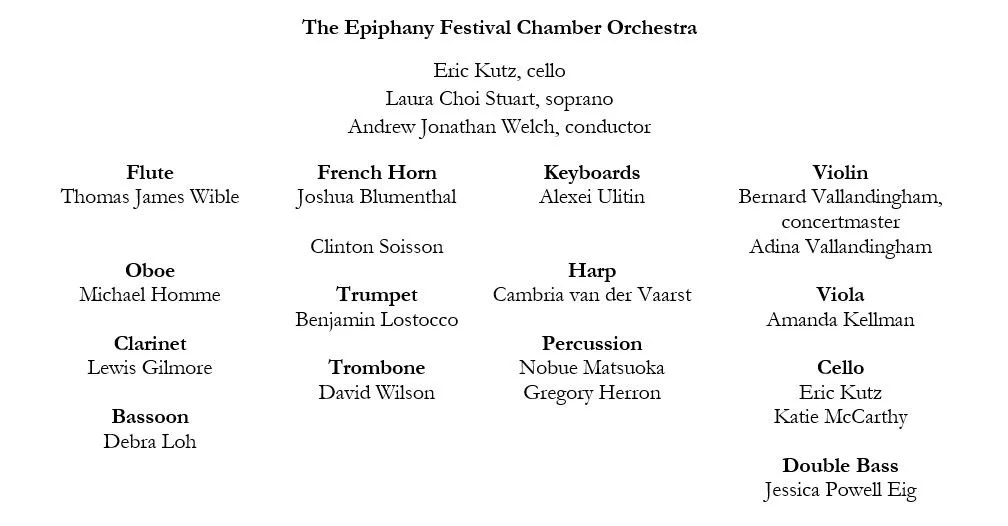
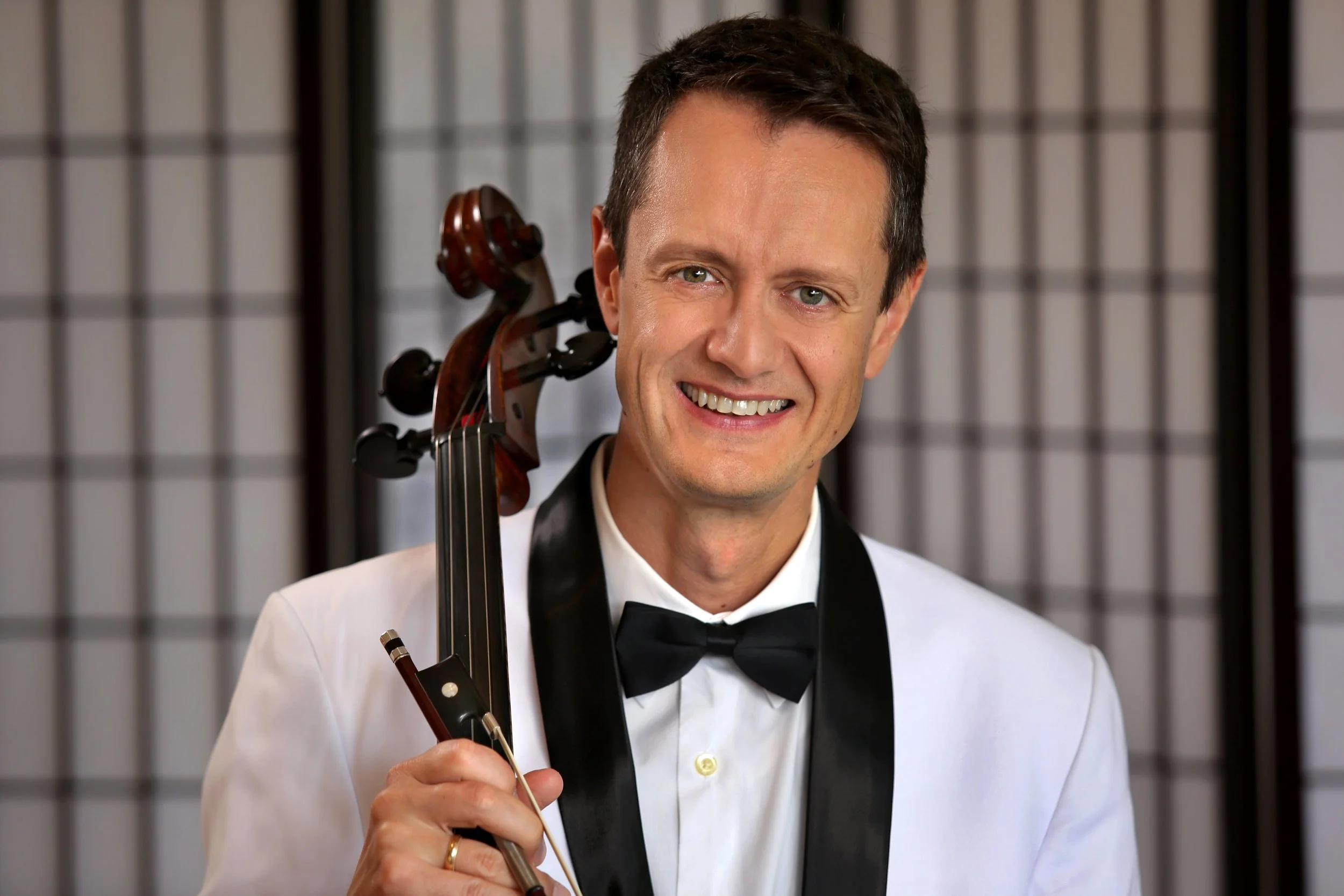
Cellist Eric Kutz has captivated audiences across North America, Asia, and Europe. His diverse collaborations cut across musical styles, and have ranged from cellist Yo-Yo Ma to jazz great Ornette Coleman. He is active as a teacher, a chamber musician, an orchestral musician, and a concerto soloist.
Mr. Kutz is a founding member of the Murasaki Duo, a cello and piano ensemble formed at the Juilliard School in 1996. The Duo has concertized in Asia and in 2024 completed its third European tour. Advocates for new music, the Duo actively commissions new works, in addition to performing the classics. Hailed by New York Concert Review as having “an easy virtuosity, and an unusually high level of ensemble playing” after its Carnegie Hall debut, the Duo regularly performs on chamber music series throughout the nation. The Duo’s second commercial recording, “Duo Virtuoso,” was lauded by American Record Guide as “an interesting program, played to the hilt by both parties. These are two outstanding musicians.” The disc won the Violoncello Foundation’s Fourth Annual Listeners’ Choice Award, chosen from among all cello albums released the previous year.
In 2024 Kutz released the complete Cello Suites of JS Bach on Albany Records. Fanfare Magazine raved “this disc set is therefore one of the best in a world where there is no lack of performances,” and “for sheer beauty, this may be the most beautiful playing of Bach’s suites on record.”
As an orchestral musician, Mr. Kutz summers in Chicago as a member of the Grant Park Orchestra’s cello section. He has also appeared in the section of the National Symphony, the New York Philharmonic, the Minnesota Orchestra, and the Saint Paul Chamber Orchestra. He has been principal cellist of the Houston Grand Opera Orchestra and the Juilliard Orchestra, and he has performed under the batons of Sir Georg Solti, Kurt Masur, and Seiji Ozawa, among many others.
Kutz traveled to the Tchaikovsky Conservatory in Moscow as a visiting artist, performing new chamber works by American composers. Other performance highlights include a tour of Germany and a concert in New York’s Avery Fisher Hall as part of Lincoln Center’s Mozart Bicentennial celebration. He has premiered over two-dozen works, and has been broadcast live on WQXR and WNYC, both of New York City, WFMT Chicago, as well as nationally on PBS television’s Live from Lincoln Center.
Mr. Kutz joined the faculty of the University of Maryland School of Music in 2015, where he performs as a member of the Left Bank Quartet. Previously he was a professor at Luther College, where he served from 2002-2015, and prior to that, Mr. Kutz was the cellist of the Chester String Quartet for four years. The Quartet, called “one of the best and brightest of the country’s young string quartets” by the Boston Globe, gave two tours of Europe during Kutz’s tenure, and performed from coast to coast.
Mr. Kutz holds degrees from the Juilliard School and Rice University. He performs on a cello by Raffaele Fiorini (Bologna, 1877), and a bow by Jacob Eury (Paris, 1810).
Program Notes
The celebrated Jean Sibelius, decidedly the best-known of all Finnish composers, appropriately serves as a fulcrum for the first two of the three main Epiphany Festival concerts. Unlike his celebrated second and fifth symphonies, however, the seventh is a remarkably compact work of a brilliant, one-movement form. Sibelius began generating ideas for both the sixth and the seventh symphonies while he was revising his fifth: together the trio would comprise his last contributions to the symphonic genre. He was said to have remarked that if he could compose a symphony finer than his seventh, he would write it. Instead, what followed was one of the most remarkable periods ever of musical silence: the now internationally famous and demanded composer, who could have solicited any number of major commissions, instead had nothing more to write.
Though it is not performed as often as most of the other six Sibelius symphonies, Symphony no. 7 is treasured by conductors, historians, and composers alike. Esa-Pekka Salonen’s Mania, our opening work on the program, has relentless forward momentum supplied by both the solo cello and ensemble, and would seem to have little in common with the Sibelius. Salonen has confirmed, however, that Sibelius 7 serves as a model for his own composition. Salonen writes of Mania:
“I have always been interested in virtuosity. There is a very strange kind of beauty in the idea of a performer doing extremely difficult things for other people to enjoy. The best kind of virtuoso is a musician, who is willing to go to places nobody has gone before; a virtuoso of mind as well as fingers. Most of my instrumental music is about challenging fellow performers, sometimes pushing them to their physical (of mental) limits, but always with respect and empathy. The best thing about conducting to me (apart from the music itself) is the thrill of sensing the energy of talented and dedicated people on stage. When composing, I try to imagine that particular kind of radiation, especially when the lonely existence in my studio feels frustratingly slow and devoid of adrenaline, which performers of course enjoy sometimes more than they'd wish. Mania was written for Anssi Karttunen, a close friend and a much admired colleague, whom I have known since the distant days of playing first horn in my early teens in the Junior Orchestra of the Sibelius Academy, where Anssi was the solo cellist.”
Standing between these two closely linked works is Kaija Saariaho’s Quatre instants, completed in 2002 for its version with soprano and piano and heard tonight in its 2017 version for soprano and chamber orchestra. Like Mania, it was written for a specific performers, in this case, soprano Karita Mattila. Though these four songs feature highly virtuosic writing for almost every instrument in the ensemble, the overall effect is very different from both Mania and Sibelius 7, and the four poems evoke a very different affect and atmosphere through their writing. Saariaho writes of her work:
“Quatre instants was born from Karita Mattila's desire to have a new work to perform at recitals she was giving at the Châtelet Theatre and Barbican Centre in April 2003. From my initial discussions with her, and knowing the vastly expressive spectrum of her voice, I immediately had a clear idea of the feelings that I wanted this work to evoke. I imagined a whole section of music built of contrasting images, sub-sections of which would be compressed into short but powerful moments. This reflection also gave the work its title: ‘Four Instants’. The fact that these instants are associated with different faces of love is without doubt connected with the fact that I have seen Karita playing the role of a loving woman in so many opera productions.”
It is a delight to program these three essential Finnish composers together on one program: together they form a mighty trinity of Finnish music, the northern country’s answer to the ‘three B’s’ of music (Bach, Beethoven, Brahms) with a modern trinity of “3 S’s.”
-AJW
Translations
Kaija Saariaho, Quatre instants
I Attente
Je suis la barque qui dérive
Mon amant est sur l'autre rive
Et la mer est si vaste
Je suis la barque qui dérive
Mon amant est sur l'autre rive
Et le vent est tombé
J'ai déployé toutes les voiles
Pour que le vent me pousse
J'ai déployé toutes les voiles
Pour que l'amant me voie
I Expectation
I am the drifting boat
My lover is on the other shore
And the sea is so vast
I am the drifting boat
My lover is on the other shore
And the wind has died down
I have spread all my sails
For the wind to push me
I have spread all my sails
For my lover to see me
II Douleur
Je ne voulais pas croiser son regard
Le remords me brûle
Mes yeux se sont tournés vers lui
Mes yeux ne m'ont pas obéi
Je ne voulais pas croiser son chemin
Le remords me brûle
Mes pas m'ont conduite vers lui
Mes pas ne m'ont pas obéi
Cette nuit-là, je m'en souviens,
La lune était pleine
Ma porte s'est ouverte à lui
Puis, doucement, refermée
Je ne voulais pas que ses bras m'enlacent
Le remords me brûle
Mon corps a dérivé vers lui
Mon corps ne m'a pas obéi
J'aurais tellement voulu le garder
Le remords me brûle
Un jour de plus, une autre nuit
Il ne m'a pas obéi
Cette nuit-là, je m'en souviens,
La lune était pleine
II Torment
I didn’t want to meet his gaze
I am burning with remorse
My eyes turned to him
My eyes didn’t obey me
I didn’t want my path to meet his
I am burning with remorse
My steps took me to him
My steps didn’t obey me
That night, I remember,
The moon was full
My door opened to him
And quietly closed again
I didn’t want his arms to hold me
I am burning with remorse
My body drifted to him
My body didn’t obey me
I so wanted to keep him by me
I am burning with remorse
One more day, one night more
He didn’t obey me
That night, I remember,
The moon was full
III Parfum de l'instant
Tu es auprès de moi
Mais je ferme les yeux
Pour t'imaginer
Nos lèvres se frôlent
Nos doigts s'emmêlent
Nos corps se découvrent
Mais je ferme les yeux
Pour rêver de toi
Tu es le parfum de l'instant
Tu es la peau du rêve
Et déjà la matière du souvenir
III Scent of the Instant
You are by me
But I close my eyes
So I can imagine you
Our lips touch
Our fingers intertwine
Our bodies uncover themselves, each other
But I close my eyes
So I can dream about you
You are the scent of the instant
You are the skin of a dream
And already what memories are made of
IV Résonances
Ma porte s'est ouverte à lui
Puis, doucement, refermée
J'ai déployé toutes les voiles
Pour que l'amant me voie
J'aurais tellement voulu te garder
Nos doigts s'emmêlent
Nos corps se découvrent
Tu es le parfum de l'instant
Tu es la peau du rêve
J'aurais tellement voulu te garder
Nos corps se découvrent
Mais je ferme les yeux
J'aurais tellement voulu te garder
Le remords me brûle
Mais je ferme les yeux
Je suis la barque qui dérive
Mon amant est sur l'autre rive
Et le vent est tombé
Text by Amin Maalouf
IV Echoes
My door opened to him
And quietly closed again
I have spread all my sails
For my lover to see me
I so wanted to keep you by me
Our fingers intertwine
Our bodies uncover themselves, each other
You are the scent of the instant
You are the skin of a dream
I so wanted to keep you by me
Our bodies uncover themselves, each other
But I close my eyes
I so wanted to keep you by me
I am burning with remorse
But I close my eyes
I am the drifting boat
My lover is on the other shore
And the wind has died down
English translation by Aleksi Barrière